DES303 Week 2: Preparing My Tech Demo — "Start Your Startup"
This week I'm reflecting on my tech demo preparation using Gibbs' Reflective Cycle. Instead of demonstrating a specific software tool or craft technique, I chose to teach my peers something I've learnt through lived experience: how to actually build a startup from scratch. But getting to that decision was a journey in itself.
Description — What happened?
This week was about deciding what to teach, building the presentation, and preparing to deliver it. The process ended up being much more involved than I expected — not because the slides were hard to make, but because choosing the right topic took real thought.
The brainstorming phase
I started the week with a long list of possible tech demo topics. In Week 1, I'd narrowed it down to four: full-stack web dev with AI, game dev in Godot, hardware prototyping, and advanced Figma. But when I sat down to actually plan one of these into a 15-minute demo, I realised I had a problem.
I kept brainstorming more options: how to build a design system, basics of machine learning, how to create your own personal design brand, web development fundamentals. The list kept growing, but none of them felt right. And the reason was always the same — 15 minutes is not enough time to teach someone a technical skill from scratch.
So I stepped back and asked a different question: instead of "what skill can I demo?", I asked "what is the most valuable thing I could give my peers in 15 minutes?"
Brainstorming process — eight ideas rejected before landing on startup thinking as the most valuable 15-minute topic.
Why startups?
The answer came from thinking about the bigger picture. We're in an era where AI is rapidly changing the design and tech industries. Designers and programmers are both facing uncertainty about their roles — tools like AI can now generate layouts, write code, and produce assets that used to require years of skill development.
So what does that mean for a room full of design students about to graduate? In my view, the most future-proof skill isn't any particular software tool — it's knowing how to identify a problem, build a solution, and bring it to market. That's startup thinking.
I wanted to open their eyes to that possibility. Not to tell everyone to drop out and start a company, but to show them a framework for thinking about problems and solutions that would be useful whether they start a business, freelance, or work at a studio. And crucially, I could teach this in 15 minutes because it's a way of thinking, not a technical procedure.
I also realised I was uniquely positioned to teach this. I've co-founded Unimate (a registered company), built and deployed multiple products (Ticker, Uniconnect, Reboot Toolbox), and gone through the actual process of pitching to universities and investors. This isn't theoretical knowledge for me — it's lived experience.
Decision funnel — from broad options to a focused topic.
Research and preparation
Once I committed to the topic, I needed to figure out how to structure it. I spent time watching lectures and videos about startups — there's a huge amount of content online. But most of it fell into two categories: either oversimplified "just start building" motivational content, or hour-long deep dives too detailed for 15 minutes.
The breakthrough came when I found Sam Altman's Y Combinator lecture series, "How to Start a Startup." Altman's framework — that startup success is the product of Idea × Product × Team × Execution × Luck — immediately clicked for me.
I didn't just copy the lectures though. I reinterpreted the framework — filtering it through what I think would resonate with design students specifically. I emphasised the problem-finding aspect (which designers are already trained for), the importance of starting simple (which connects to prototyping culture in design), and the value of talking to users (which connects to user-centred design research).
Building the presentation
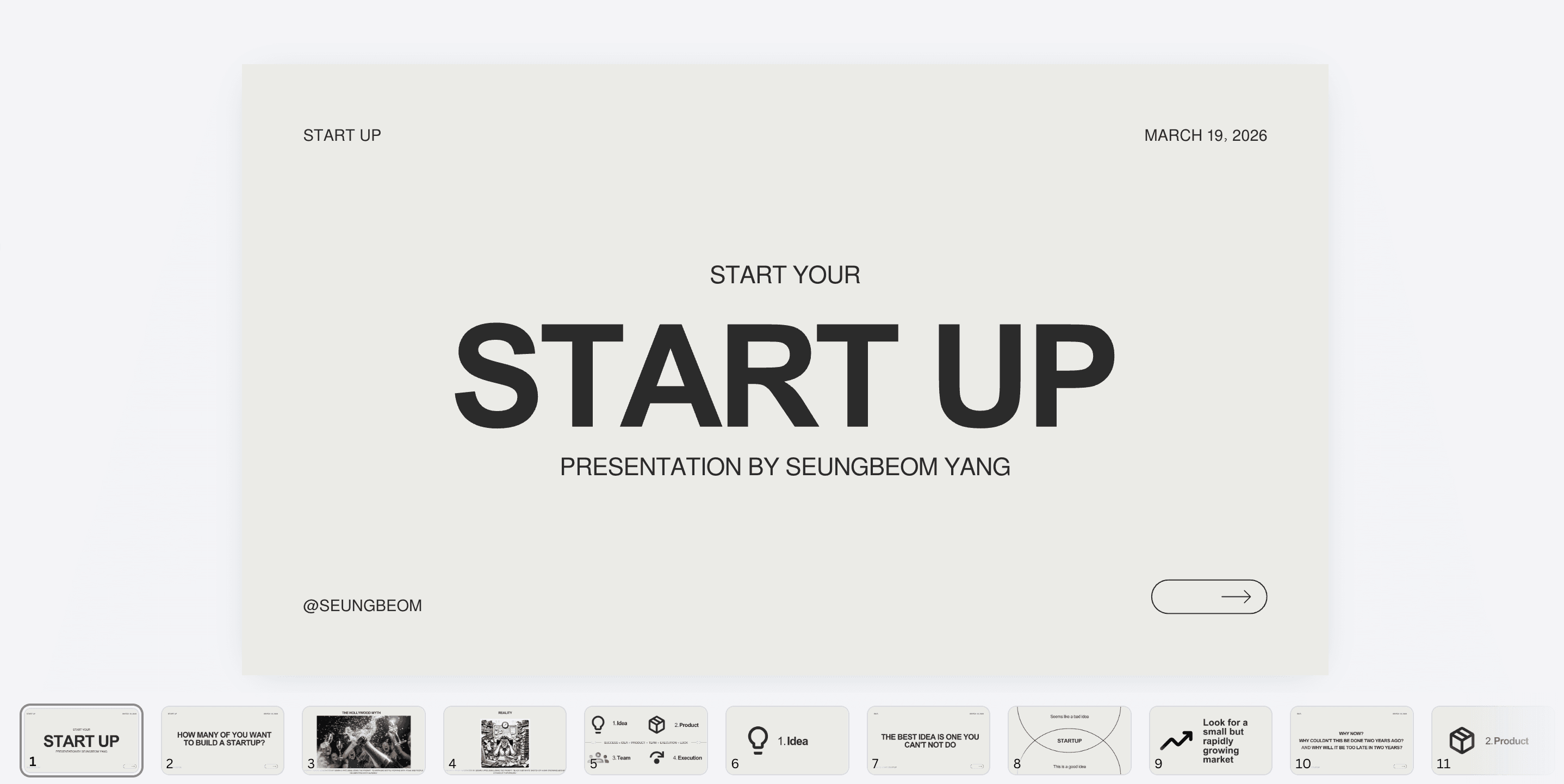
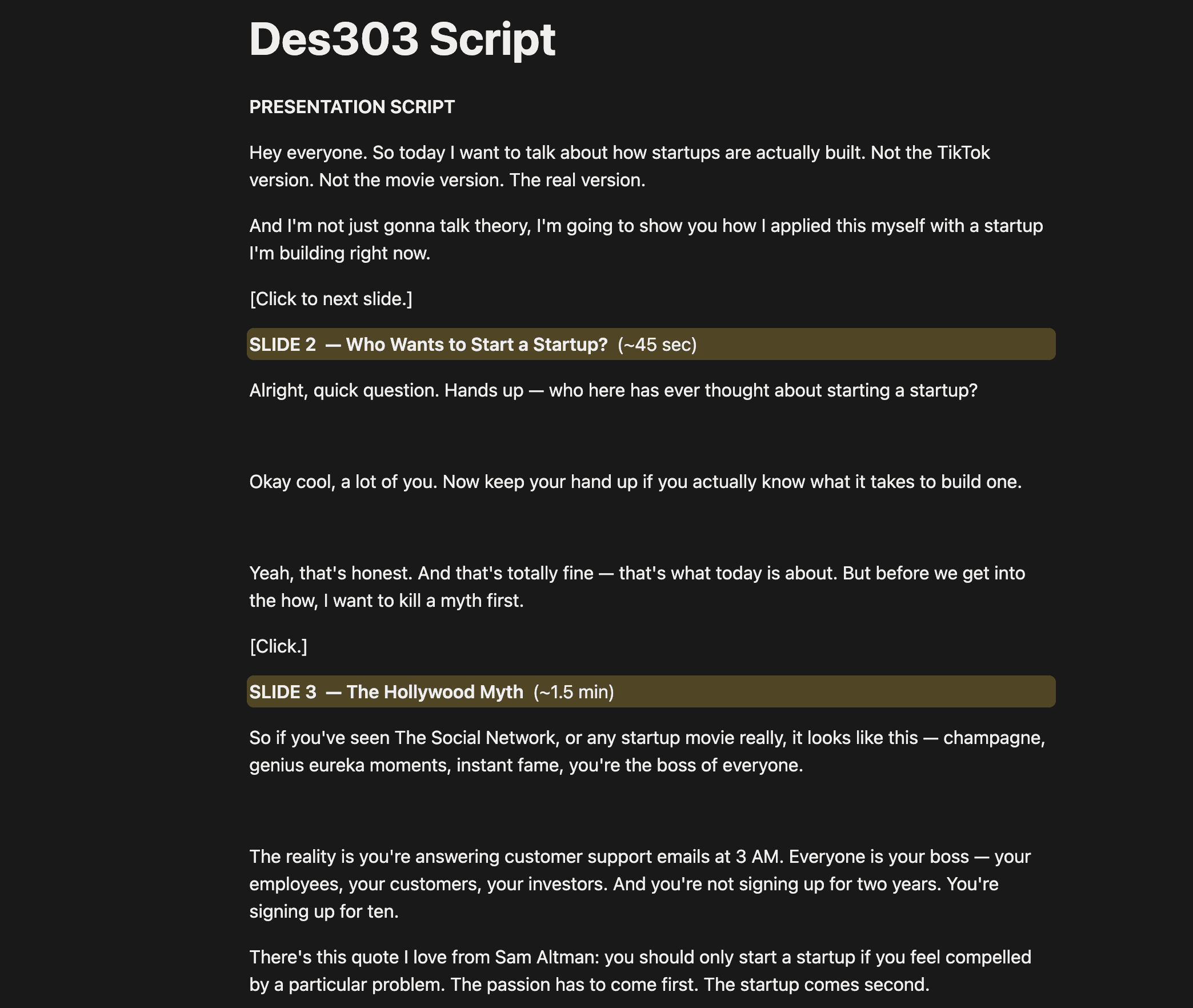
I built the slides in Canva using a cream-and-black minimal aesthetic. I wrote a full speaker script for all 33 slides — something I've never done before for a presentation. I wanted to make sure every transition was tight and every example landed clearly.
The structure followed Altman's framework but with my own twist: for each of the four pillars (Idea, Product, Team, Execution), I first explained the principle, then immediately showed how it played out with Unimate. I included real data (68% of first-year students get lost on campus, 28% experience navigation anxiety), real prototype photos (three iterations of the physical kiosk), and our actual team photo.
The final design decision was adding an interactive activity at the end. I gave the audience three prompts — "What problem bugs you every day?", "Why now?", and "Who would be your first 10 users?" — and gave them time to brainstorm.
Feeling — How did I feel?
The brainstorming phase was frustrating at first. Going through eight or nine different ideas and rejecting all of them felt like I was wasting time. But once I reframed the question from "what skill?" to "what's most valuable?", everything clicked. That shift in thinking was actually exciting — it felt like a genuine insight rather than just picking from a list.
Once I landed on the startup topic, I felt genuinely energised. This wasn't a demo I was doing because I had to — it was something I wanted to share. The personal connection to Unimate made the preparation feel meaningful rather than like coursework.
At the same time, I was nervous about two things. First, scope: 33 slides is a lot for 15 minutes. Second, relevance: would design students actually care about startup frameworks?
The research phase — watching Sam Altman's lectures — was genuinely enjoyable. It reinforced a lot of what I've learnt through trial and error with Unimate, but put it into a clearer framework.
By the end of the week, I felt prepared content-wise but under-rehearsed. I'd only done one full spoken run-through. The familiar pattern: I spent more energy making the thing than practicing how to present the thing.
Evaluation — What was good and bad?
- +Rejecting obvious choices led to a more original, meaningful topic
- +Grounding YC framework in Unimate gave every point a concrete, authentic example
- +Writing a full script forced thinking about pacing and transitions
- +Interactive ending reflected my philosophy: don't just lecture, give people something to do
- -Too long on slide design, not enough rehearsing out loud
- -Didn't check in with demo group beforehand to understand their interests
- -33 slides for 15 minutes is objectively too many — scope management problem
Analysis — Why did this happen?
Looking at this week through a wider lens, I can see several patterns in how I work as a designer and maker.
The reframing insight was the most important moment.
Shifting from "what skill do I know?" to "what's most valuable in 15 minutes?" is actually the same design thinking I apply to product development — don't start with your solution, start with the user's need. It's interesting that this principle came naturally to me for the topic selection but I failed to apply it to my actual preparation (not checking in with peers).
My background shaped this decision.
The reason I could even see "startup thinking" as a viable demo topic is because of my unique position straddling design and computer science, combined with actual startup experience. Most design students haven't registered a company, negotiated with universities, or iterated physical prototypes.
The AI-era reasoning reflects my positionality as a designer.
I see design not as creating pretty things but as solving problems. In a world where AI can generate visuals and write code, the distinctively human skill is identifying which problems matter and orchestrating solutions.
The over-scoping pattern is real.
33 slides, multiple startups, a full Y Combinator framework, AND an interactive activity — I tried to fit everything in because I'm passionate. Passion creates ambition, ambition creates scope, scope creates stress. I need to learn that cutting content isn't losing value — it's focusing it.
The maker bias persists.
I spent more time building slides than practicing delivery. This comes from my coding background, where the output speaks for itself. But presentations are different — the delivery IS the product.
Conclusion — What can I learn?
The biggest learning this week is about the power of reframing the brief. By asking a better question ("what's most valuable?" instead of "what skill?"), I arrived at a much stronger demo topic. This is a transferable design skill — whenever I feel stuck on a project, I should question whether I'm solving the right problem rather than pushing harder on the wrong one.
I've also confirmed that my strongest work comes from personal experience and genuine passion. The Unimate case study gave the presentation an authenticity that a generic tutorial wouldn't have had.
The practical takeaway is about preparation balance. Content quality was high, but delivery readiness was low. I need to shift my time allocation — less polishing, more rehearsing — and I need to treat audience research as a non-negotiable step, not an optional extra.
Finally, I've learnt something about my positionality as a designer. My background in coding, startup building, and product development gives me a perspective that's different from most of my design peers. Rather than seeing this as a gap (I can't sketch as well as them), I should see it as a strength. This demo was the first time I leaned fully into that perspective, and it felt right.
When you're stuck, don't push harder on the wrong question — reframe it. "What skill?" became "What's most valuable?" and that changed everything.
Action Plan — What will I do differently?
Next week: Delivering the tech demo and reflecting on the experience and my peers' presentations.
References
Altman, S. (2014). How to Start a Startup: Lecture 1 — How to Start a Startup [Video lecture]. Y Combinator / Stanford University. Retrieved from https://www.youtube.com/watch?v=CBYhVcO4WgI
Reynolds, G. (2012). Presentation Zen: Simple Ideas on Presentation Design and Delivery (2nd ed.). New Riders.
TED. (n.d.). TED speaker guide. Retrieved from https://www.ted.com/participate/organize-a-local-tedx-event/tedx-organizer-guide/speakers-program/prepare-your-speaker