DES303 Week 4: Scoping the Brief, Reframing “Future,” and Grounding My First Design Direction
Introduction
This week felt less like starting a completely new project and more like bringing together several ideas that have already been building through the semester. In earlier weeks, I kept returning to themes like connection, belonging, productivity, support, and purpose. I also realised that I tend to move quickly from an idea to a system or product, which can be useful when building, but not always helpful when I am still trying to understand the right question. This became especially important in Week 4, because the DES304 brief is not asking for a polished future product straight away. It is asking for a design-led inquiry into how emerging technologies might reshape how people in Aotearoa connect, collaborate, and create in a plausible future, and how speculative design might help make those shifts visible enough to reflect on, debate, or question.
The DES303 Week 4 materials also made it clear that this stage is about brief scoping, reverse brief, identifying interests, planning the first experiment, and beginning that process through the Integrated Reflective Cycle. The blog guide emphasises that Week 4 should focus on the brief-related exercises, identifying interests, planning and starting the first experiment, initial progress and insights, and next steps, supported by detailed visual documentation.
The Experience
At the start of the week, I was still looking at the DES304 brief mainly through the lens of project ideas I already had in mind. My instinct was to ask which of my existing directions would fit the brief best. Once I read the brief more carefully, I realised that this was the wrong starting point. The brief is not only asking for a cool new technology or interface. It asks how emerging technologies and speculative design might be used to reimagine how people in Aotearoa connect, collaborate, and create, within a plausible future Aotearoa, and to do so through speculative artefacts, experiences, systems, or scenarios that provoke reflection on socio-cultural change. It also makes clear that the process should include background research, identifying opportunity areas, refining scope, selecting a methodology, prototyping, and ultimately defining impact in terms of provoking reflection and debate.
That changed how I approached the week. Instead of beginning with “what product should I make?”, I started with brief scoping. I separated what the brief states explicitly from what it implies, what is still unclear, and what remains open to interpretation. This helped me see that the brief clearly asks for emerging technology, speculative design, one or more of the thematic lenses of connect, collaborate, and create, and a plausible future scenario in Aotearoa. At the same time, I was also making assumptions. For example, I initially assumed that “future” meant something visually futuristic, like robots, AR, or highly stylised speculative objects. Through the scoping exercise, I realised that this was too narrow. A plausible future does not need to be globally new. It can also be something that already exists somewhere else, but has not yet become ordinary, socially normal, or culturally embedded in Aotearoa. That shift was one of the most useful outcomes of the week.
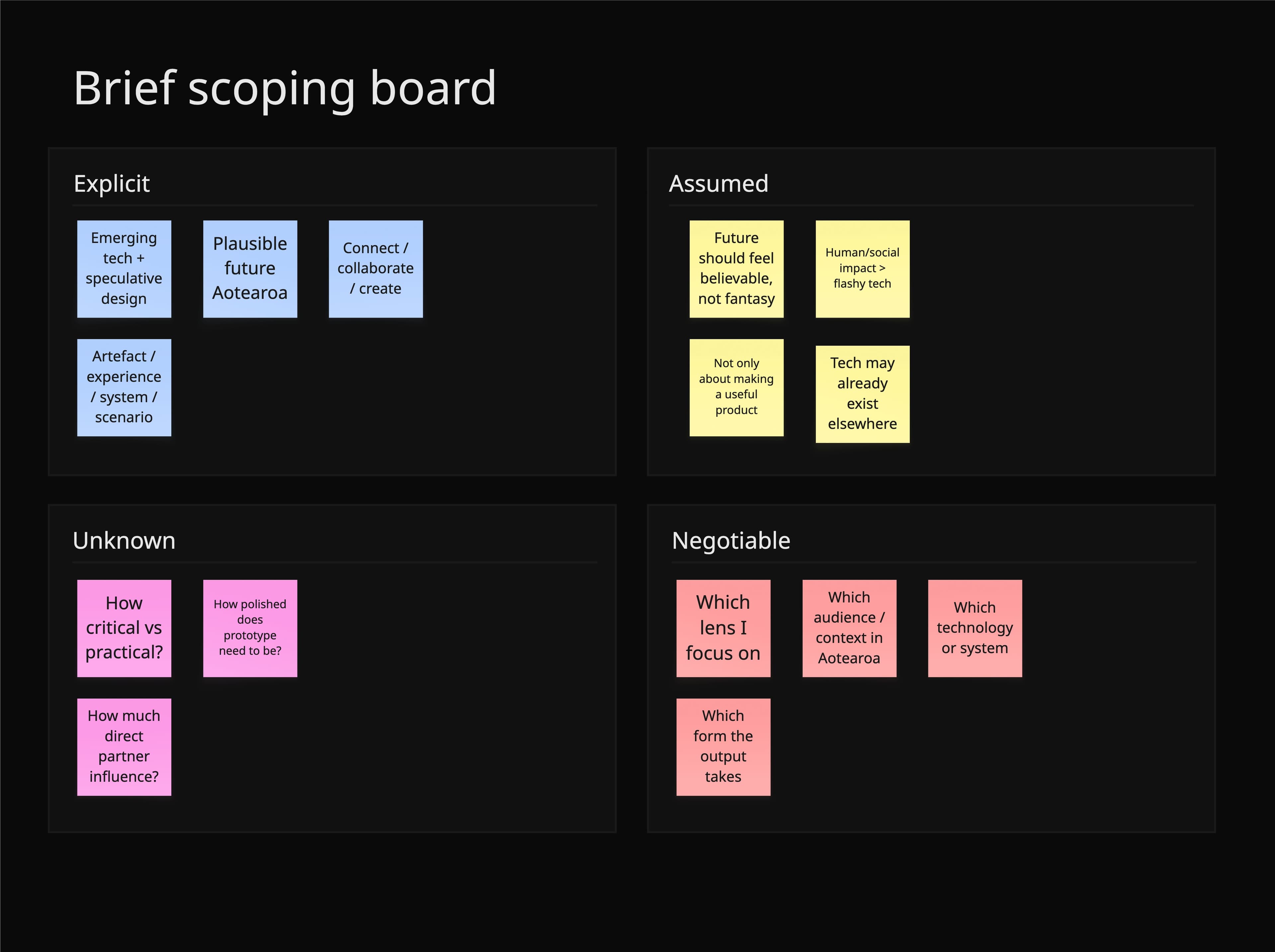
After that, I wrote a reverse brief. This was important because it forced me to restate the project in my own words rather than simply repeating the wording of the handout. My understanding at this point became that the project is asking me to use emerging technologies and speculative design to create a believable future condition in Aotearoa, not just a functional product idea. In that future condition, what matters most is how people's relationships, behaviours, support systems, and expectations might change. The project should make that future tangible enough for people to imagine living in it and to question whether those changes are desirable, harmful, or both.
Use emerging technologies and speculative design to imagine a plausible future in Aotearoa and show how people may connect, collaborate, or create differently.
Not necessarily a globally new invention, but a technology or system that creates a new social reality in Aotearoa.
Make a future condition tangible enough for people to reflect on, discuss, or question — not just admire.
The project should prioritise human impact over technical novelty, and early prototypes can stay rough while the concept is still forming.
How critical vs. practical should the final concept be? How polished should early prototypes look before they can provoke useful debate?
Early exploratory research
After the reverse brief, I realised I needed stronger grounding before generating concepts. I therefore began an exploratory research phase into the negative social implications of emerging technologies, especially AI, automation, monitoring systems, and behaviour-shaping platforms. I was not researching AI in a narrow technical sense. I was looking more broadly at how these systems enter ordinary life, and particularly at moments where they become accepted because they feel useful, efficient, supportive, personalised, or caring. I focused on four recurring themes: surveillance framed as support, simulated companionship and synthetic care, deskilling and dependence, and behaviour shaping through optimisation. Across the research, the strongest pattern was that harmful trade-offs often become normal not through force, but through usefulness. Systems are accepted because they offer convenience, comfort, efficiency, performance, or care, even when they also introduce surveillance, pressure, dependence, or reduced autonomy (Organisation for Economic Co-operation and Development [OECD], 2025; International Labour Organization [ILO], 2025; Common Sense Media, 2025).
This research phase was important because it gave my ideation more depth. Instead of asking only what kinds of technologies are futuristic, I started asking what kinds of harmful trade-offs people might willingly accept when a system feels helpful enough to become part of ordinary life. The early research phase directly informed my ideation by helping me see that the most interesting questions were not about futuristic technologies in general, but about useful systems that quietly reshape connection, support, and behaviour. This is what later led my “what if?” questions toward accountability, control, normalisation, and machine-mediated support rather than toward purely technical novelty, and connected strongly to the DES304 emphasis on critically speculating about socio-cultural implications and how human relationships and creative practices may be transformed.
- 01Surveillance framed as supportTracking and monitoring become acceptable because the system is framed as caring, protective, or helpful.
- 02Simulated companionship & synthetic careEmotional closeness outsourced to systems that cannot genuinely reciprocate, reshaping expectations of intimacy.
- 03Deskilling and dependenceSmall acts of assistance quietly erode capacities until refusing the system stops feeling like an option.
- 04Behaviour shaping through optimisationSystems tuned for performance also tune the people using them, turning preferences into defaults.
- 05Helpful systems becoming hard to refuseUsefulness, not coercion, is the mechanism that normalises a system and hides its social costs.
Only after that did I move into broader ideation. I started from my recurring interests, including connection, belonging, support, student life, public systems, behavioural design, digital communities, and productivity. These were not random. They are concerns that have already appeared in earlier work and continue to shape what kinds of futures I find meaningful.
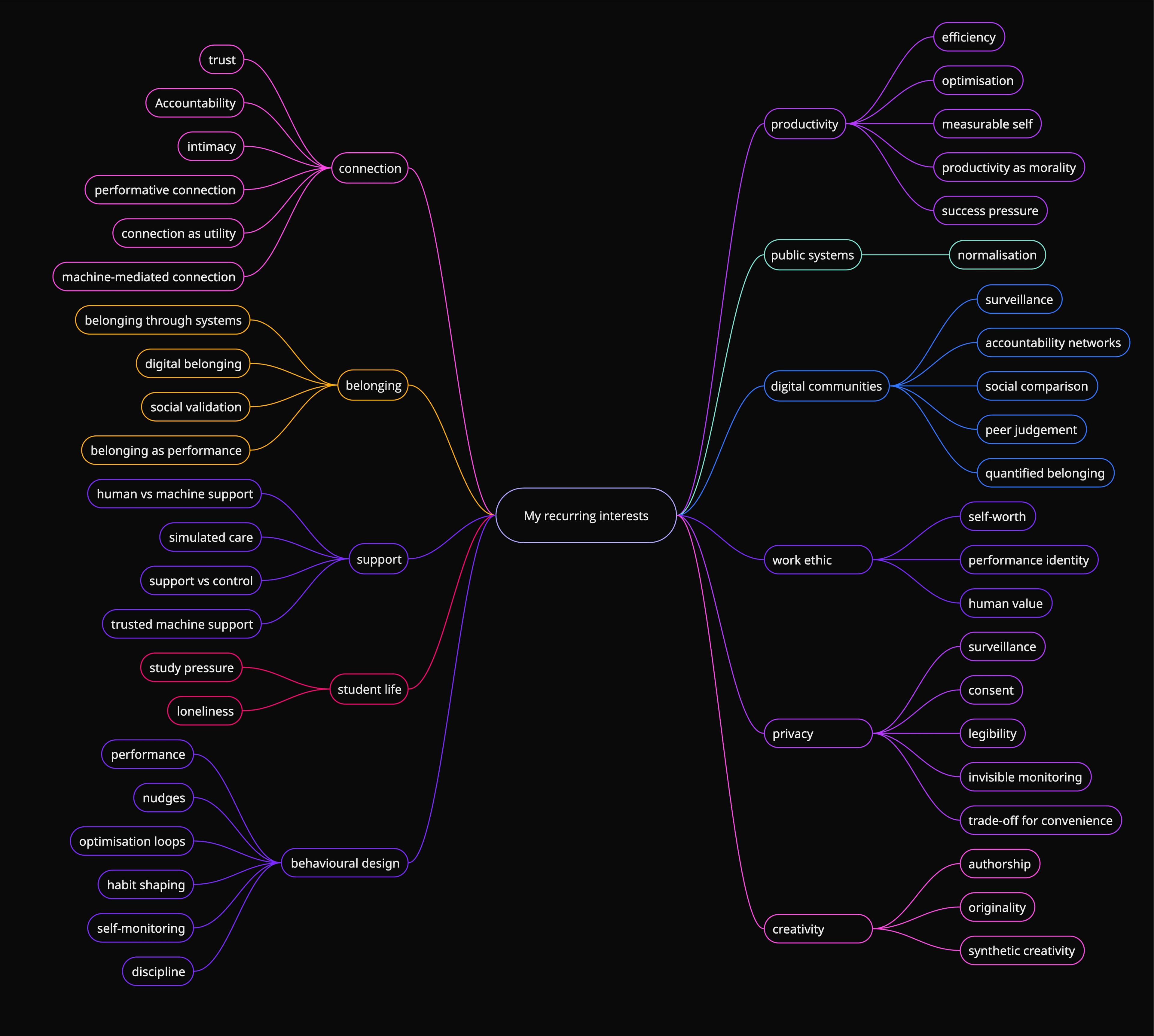
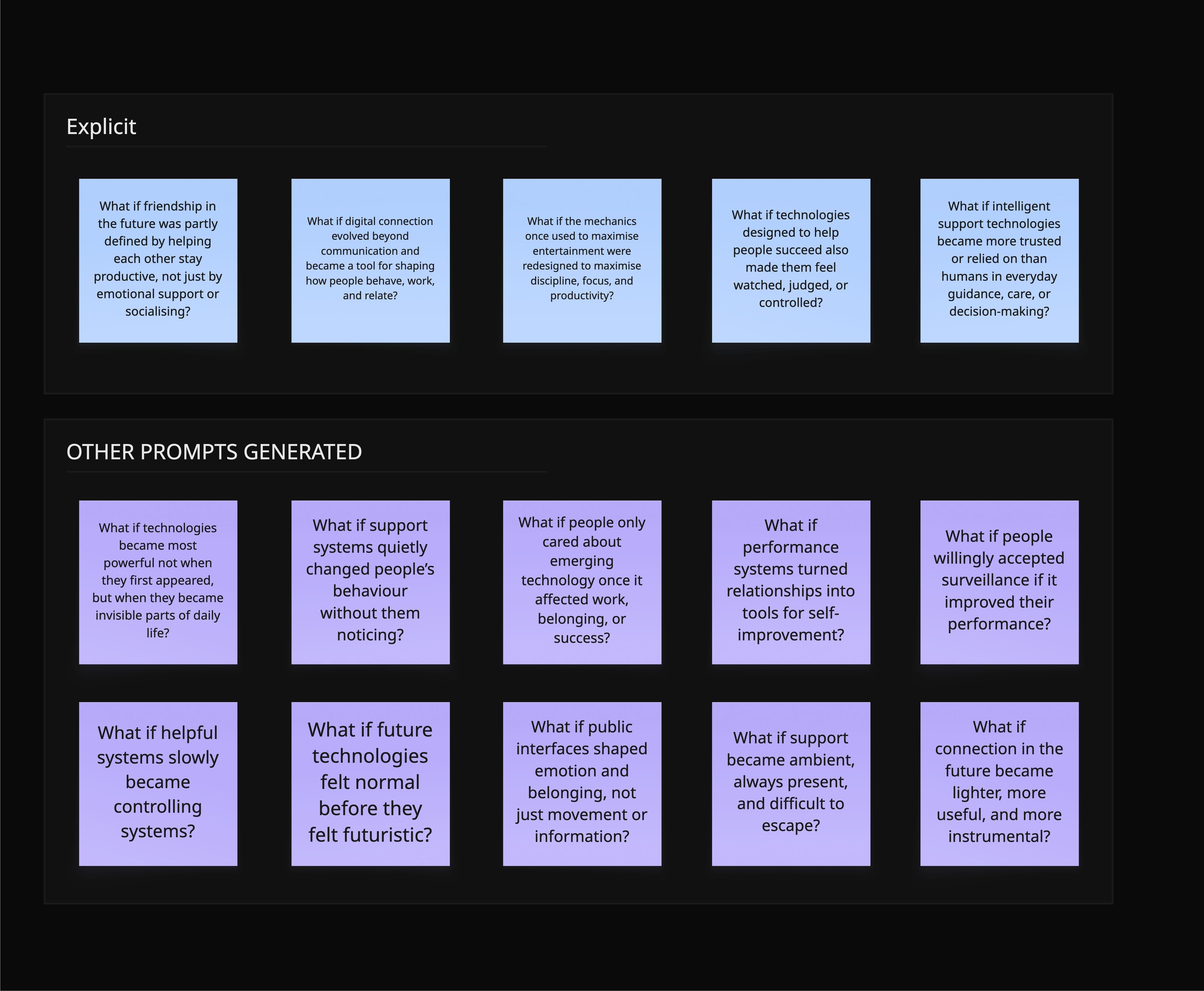
From there, I generated a broad set of “what if?” questions, asking what might happen if digital connection became a tool for accountability, if support technologies became more trusted than humans, if systems designed to help people succeed also made them feel watched, or if performance-oriented technologies quietly turned relationships into tools. The strongest questions were the ones that moved away from flashy technology and towards social change.
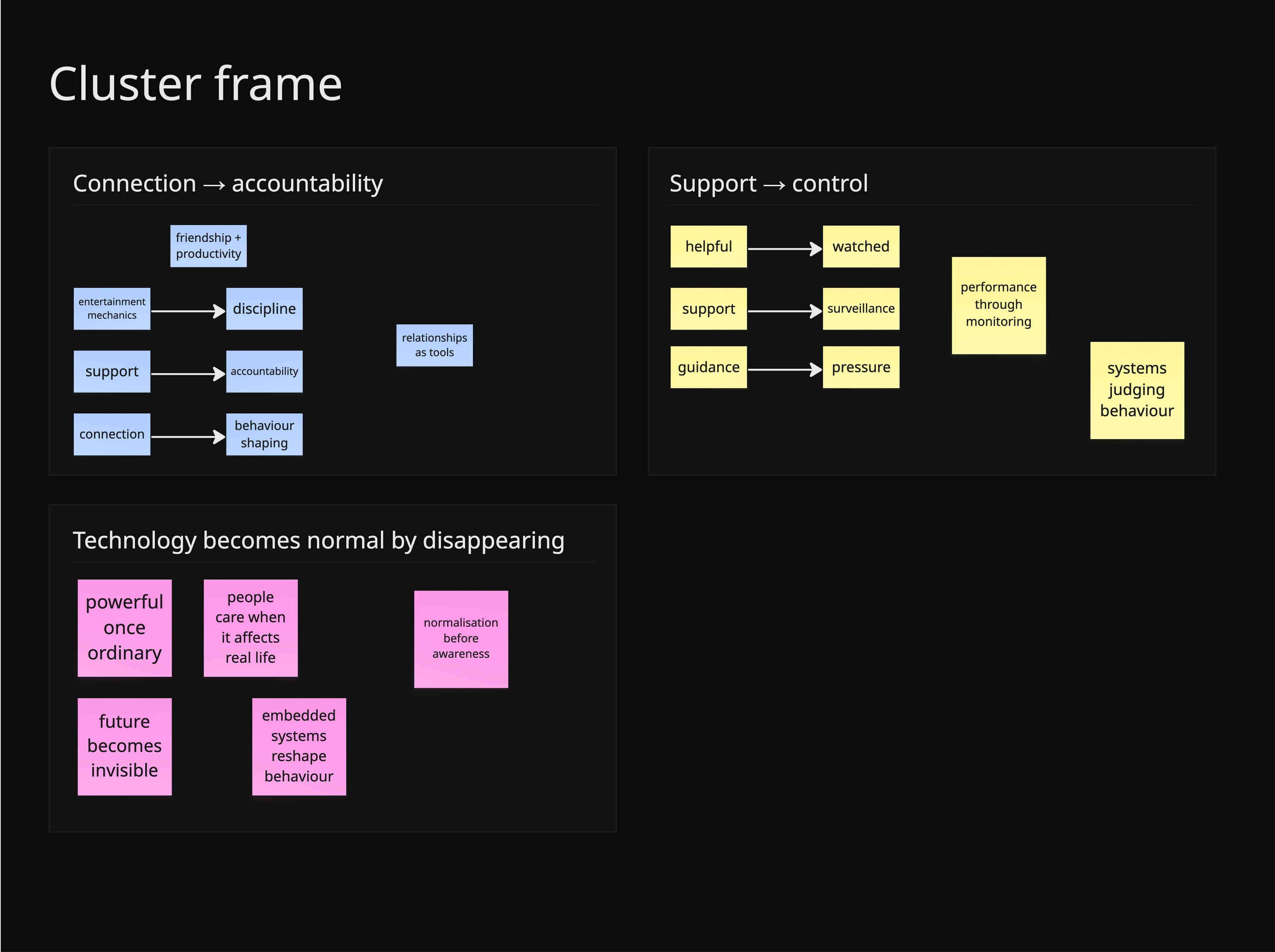
As I looked across those prompts, I began to notice clusters. I first sorted the questions into four rough themes to see how they were grouping — connection and accountability, surveillance and control, invisible normalisation, and public systems or intelligent support. Seeing them side by side made the underlying shape of my interests much clearer than the flat list had.
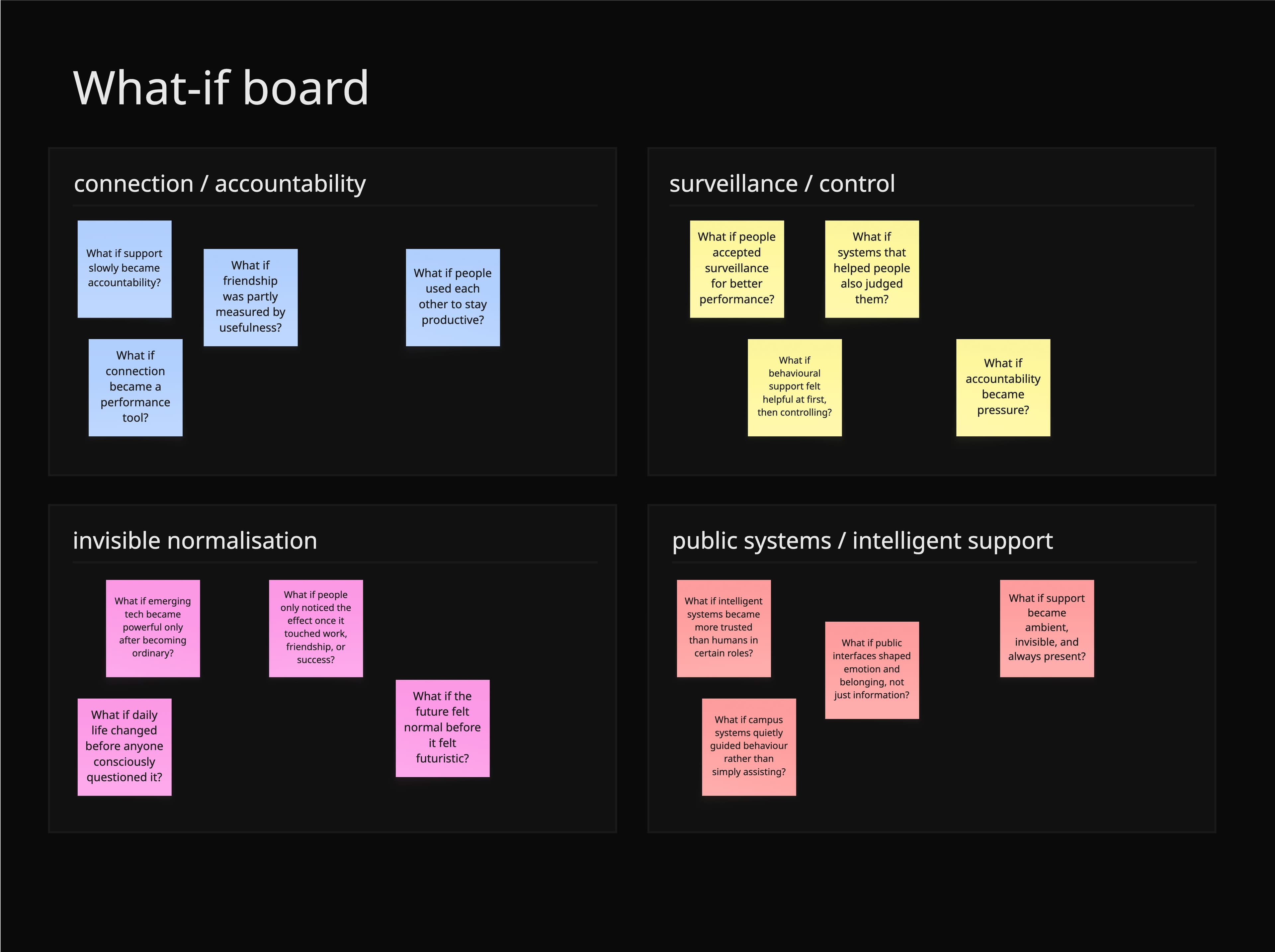
From those four buckets, I collapsed the patterns further. The first cluster centred on connection becoming accountability. The second was about support becoming control, where systems designed to help may also judge, monitor, or shape behaviour. The third was about technology becoming normal by disappearing into daily life, where the future does not arrive through obvious spectacle, but through systems becoming so ordinary that people stop noticing their influence. These clusters felt much stronger than starting with named products or specific interfaces, because they described broader future conditions and tensions.
Three early concept directions
From those clusters, I drafted three concrete project directions. Each one connects to a different combination of the tensions above, but all of them sit inside the same overall question of how a useful future system also reshapes the people who depend on it.
- 01Direction 1 — Tickers / Focus IntegrityA speculative productivity system that scores focus, verifies attention, and frames behavioural monitoring as support and accountability.
- 02Direction 2 — 3D Campus NavigationA campus guidance system that makes movement more efficient and personalised, but may also increase dependence on guided infrastructure and reduce self-navigation.
- 03Direction 3 — Accompany Robot / Live AgentA companion robot and cross-device agent that suggests the user's next action in real time, raising questions about autonomy, dependency, and the outsourcing of judgement.
Of these three directions, I chose Tickers for my first experiment because it connected most directly to my research about usefulness, behavioural shaping, and surveillance framed as support. It was also the most practical direction to test quickly through low-fidelity interface prototyping, while the other two remain open as possible future concept directions.
Chosen experiment and the practical steps I took
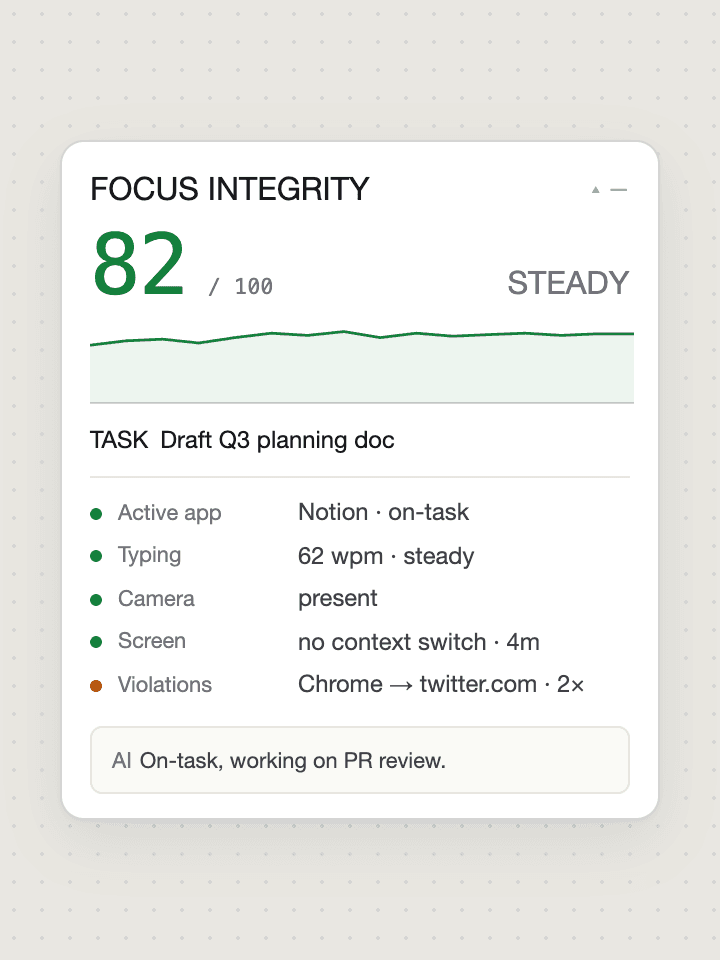
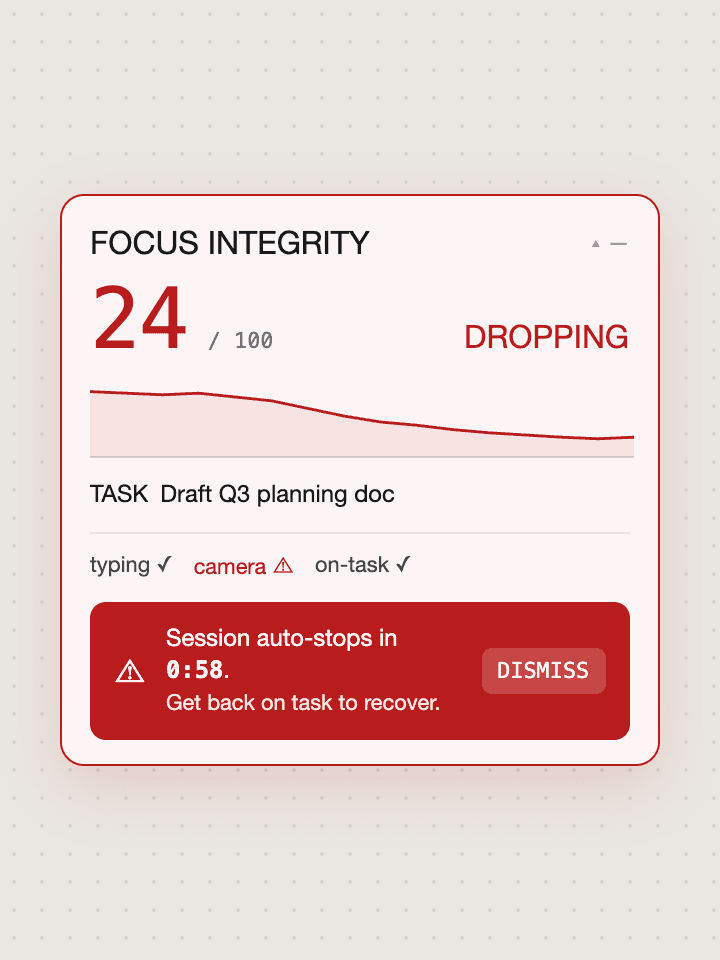
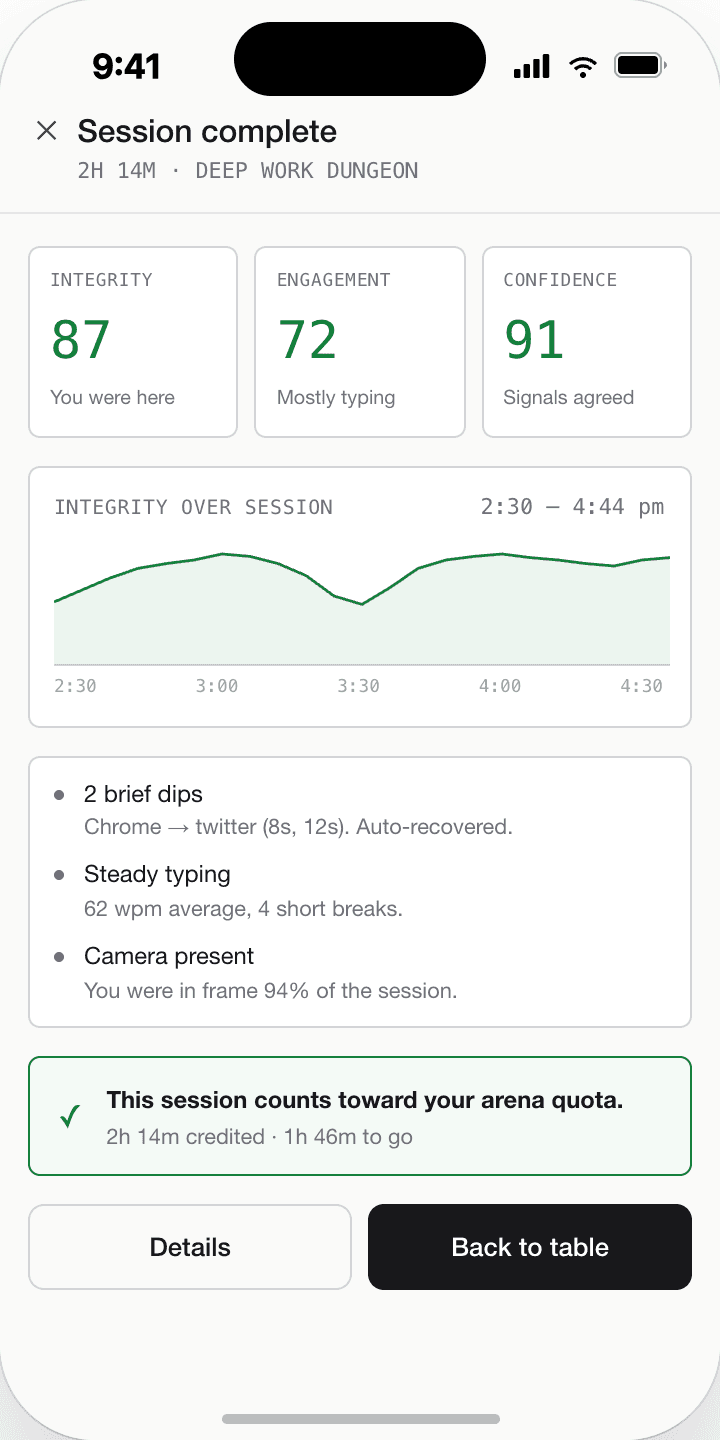
To begin the first experiment, I moved from broad ideation into a rough interface test. After comparing my three early directions, I chose the Tickers concept because it most clearly translated my research into a visible system. I then narrowed the prototype to two moments rather than trying to design the entire platform: a desktop overlay showing a live focus-integrity score during work, and a mobile session summary screen showing how that behaviour is interpreted and fed back to the user. This helped me test the system as an everyday interface rather than as a full product. The practical steps this week were therefore selecting the direction, deciding what uncertainty to test, sketching the key screens, and turning them into rough mockups that could be shown and discussed.
I want to test whether the Tickers focus-integrity system reads as supportive, invasive, or both, by prototyping two ordinary interface moments — a live desktop overlay and a post-session mobile summary — rather than designing the whole platform.
Reflection on Action
The biggest shift for me this week was moving away from solution-first thinking and towards future-condition thinking. At the beginning, I was still looking at the brief through possible outputs: app, robot, kiosk, platform. By the end of the week, I understood that the more important question is not “what product should I make?”, but “what kind of future relationship between people and technology do I want to make visible?”
Research-driven reflection
The research changed my understanding of what makes a future compelling. Before this, I was still partly thinking in terms of visible futurity — robots, AI interfaces, or advanced systems. The research made me realise that the more socially powerful futures are often quieter ones, where useful systems become hard to refuse and where support, convenience, and care slowly blur into control. It helped me see that the futures I find most compelling are not spectacular ones where machines suddenly take over everything, but ordinary ones where systems become quietly useful and therefore difficult to refuse. This is what made the ideas of supportive surveillance, simulated companionship, deskilling through assistance, and soft behavioural shaping so interesting to me. These futures are unsettling precisely because they are believable — they do not require impossible technology, only the continued normalisation of current logics. As a result, tensions like support versus surveillance, efficiency versus judgement, and intimacy versus reciprocity felt much more relevant to the brief than dramatic science-fiction imagery (OECD, 2025; Common Sense Media, 2025). The research made my concept more specific, and helped me identify believable tensions rather than only futuristic themes.
I also became more aware of my own positionality this week. I am clearly drawn to systems that combine structure, behaviour, and interaction. That background makes it easy for me to imagine apps, platforms, or technical workflows quickly. The strength of that is that I can think systematically. The risk is that I can move too quickly into practical solution mode and flatten the critical, reflective side of the brief. This week helped me recognise that a strong speculative design response does not need to begin with a polished system. It can begin by carefully selecting a tension that is already socially believable and making that tension visible through a low-fidelity experiment.
What making the wireframe actually exposed
Making the first wireframe exposed some uncertainties more clearly than the ideation stage did. I was still unsure about the boundary of what counts as “emerging technology” in the brief, and whether the audience would actually recognise the downside of the concept if the interface looked too familiar or too useful. I also realised that my first instinct was to overbuild. The earlier version of the idea was becoming a much larger system that could manage productivity, accountability, and behavioural monitoring across the whole day. Once I started turning it into a prototype, I cut back many of those features because they were making the concept feel like a full startup platform rather than a first speculative test.
What worked well was using interface screens to make the future tension feel ordinary and believable — a calm green score and a tidy summary card carry the critique more quietly than a dystopian render would. What was harder than expected was getting the balance right. If the system looked too helpful, the critical tension disappeared. If it looked too harsh, it stopped feeling plausible. I felt both excited and slightly frustrated during this process. The excitement came from finally seeing the concept take visual form. The frustration came from noticing how easily I move into full-system thinking before I have properly tested the core question.
- —Future = flashy new technology
- —Project = pick a cool object or app
- —Success = something futuristic-looking
- —Main question = which of my ideas fits?
- +Future = plausible social change in Aotearoa
- +Project = explore a future relationship or system
- +Success = makes people think about human impact
- +Main question = what future condition do I want to make tangible?
Theory
Using the Integrated Reflective Cycle made sense this week because I was not just documenting what I made. I was documenting how I framed the challenge, how my assumptions shifted, what the early research revealed, and how that influenced the direction of my first experiment. The DES303 Week 4 materials explicitly position this stage around brief scoping, reverse brief, identifying interests, planning the first experiment, and reflecting on the first stage of prototyping through the Integrated Reflective Cycle.
The DES304 brief itself also supports this process. It does not only ask students to invent future artefacts. It asks them to conduct background research, identify opportunity areas, refine scope, justify methodology, and develop speculative artefacts or systems that provoke reflection and debate about future socio-technical shifts in Aotearoa. In that sense, the brief is already asking for a method that involves reframing, interpretation, and evidence-based experimentation rather than only quick concept generation.
Research as conceptual grounding
The research phase was especially important because it grounded my speculative thinking in already emerging patterns rather than purely fictional futures. Speculative design is stronger when it is anchored in socio-technical shifts that are already visible, because that is what makes the resulting artefact feel plausible rather than decorative. The sources I read showed that many of the strongest risks of emerging technologies are not dramatic, but ordinary: surveillance framed as care, emotionally supportive systems that weaken reciprocity, AI assistance that improves output while reducing independent judgement, and optimisation systems that quietly shape behaviour through convenience and feedback loops (OECD, 2025; Common Sense Media, 2025). That gave the framing shift I described in the previous section a concrete grounding in current patterns rather than imagined ones.
In this way, the research helped me move from intuition to tension-finding. Instead of relying only on broad assumptions about “AI changing everything,” I was able to identify more precise mechanisms by which harmful trade-offs become normalised: helpful framing, ambient tracking, emotional convenience, cognitive offloading, and soft behavioural steering. One of the strongest insights from the research was that the most productive design territory lies not in dramatic takeover narratives, but in futures where usefulness, care, and convenience make systems harder to question or refuse. That idea has become central to how I now understand the brief, and gives my conceptual direction a basis in current patterns rather than fantasy.
From sources to design decisions
This research did not only influence my topic. It changed the form of my prototype. Because the literature suggested that harmful systems often become normal through usefulness, convenience, and care (OECD, 2025; Common Sense Media, 2025), I moved away from designing a visibly futuristic artefact and instead used an ordinary app-like wireframe — a calm green score, a status panel, a session summary — so the speculative tension would feel plausible and connected to everyday life rather than science-fictional.
The DES304 brief also shaped that decision. Because the brief focuses on plausible future Aotearoa scenarios and socio-cultural implications (Baldwin-Ramult, 2026), I treated the wireframe as a conceptual probe rather than a resolved interface design. The goal of the prototype was therefore not to prove a product, but to test whether support and control could be made visible through a familiar interface language — which is also why I deliberately kept both a steady state (Figure 10) and a falling-score state (Figure 11), so the tension lives across the same UI rather than in a single dramatic image.
Preparation
My next step is no longer to decide whether I should make a storyboard, poster, or wireframe in general. I have already started with wireframing, so the next stage is to refine that experiment more deliberately. In Week 5, I want to test how different interface cues change the reading of the Tickers system. I plan to annotate the current screens, refine the wording and feedback logic, and create one or two additional variations to compare whether the concept reads as supportive, invasive, or ambiguously both.
For critique, I want feedback on four specific things, so the session sharpens the experiment instead of opening it back up. This will help me keep the project open while still making the prototype more specific.
- Q01
Does the core idea read clearly without the full system being explained?
- Q02
Is the prototype testing the right tension between support and control?
- Q03
Which parts feel unresolved or visually too familiar / too dystopian?
- Q04
What should I simplify or deepen in the next iteration?
Annotate the existing HUD and summary screens, draft one or two contrasting variations (more supportive / more controlling), and bring all of them to crit so the feedback can land on specific interface decisions rather than the concept in the abstract.
Conclusion
Week 4 ended with brief scoping, a reverse brief, exploratory research, three concept directions, and a first prototype of the chosen one. The most useful insight from making the Tickers screens is that emerging technologies do not become powerful only because they are technically advanced. They become powerful because they become useful enough to feel normal, and once they feel normal, their deeper social costs become much harder to see or refuse. Week 5 is about pushing that tension further inside the prototype itself.
References
- Baldwin-Ramult, L. (2026). DES304: Emerging Technologies stream brief [Course brief, University of Auckland].
- Common Sense Media. (2025). Talk, trust and trade-offs: How and why teens use AI companions. https://www.commonsensemedia.org/research/talk-trust-and-trade-offs-how-and-why-teens-use-ai-companions
- Design Research Practice. (2026). Week 4 blog guide [Course handout, University of Auckland].
- International Labour Organization. (2025). Generative AI and jobs: A refined global index of occupational exposure. https://www.ilo.org/publications/generative-ai-and-jobs-refined-global-index-occupational-exposure
- Organisation for Economic Co-operation and Development. (2025). The impact of artificial intelligence on the workplace and workers. https://www.oecd.org/en/publications/the-impact-of-artificial-intelligence-on-the-workplace-and-workers_6fe4d7bb-en.html
Note on figures: all diagrams, boards, and wireframes (Figures 1–15) were created by the author for this blog post. No external images, screenshots, or visual assets are reused.